
Victorian and Edwardian wedding photography and more.
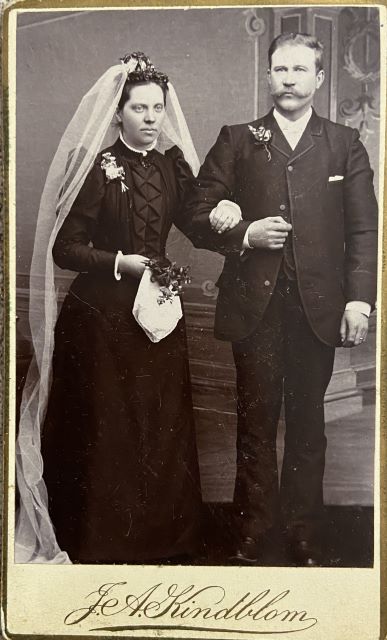

I don’t know who the people in these photos are, but they were taken in Sweden, and they are somehow connected to my family history. I remember when I first saw them, I was surprised that the brides were wearing black. But after a bit of research, I discovered that black wedding dresses weren’t that unusual back then. In fact, they were quite common.
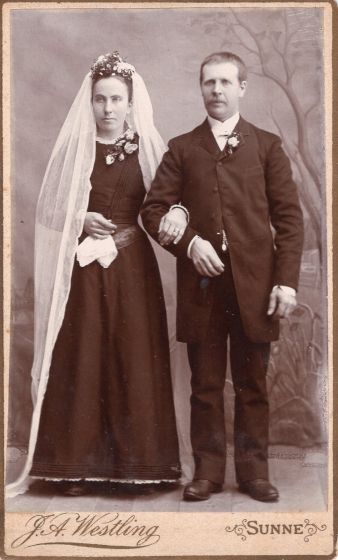
I found that most of the black dresses had a long white veil, often with little crown-like decoration on top. I read that the brides often made their own dresses, and they wanted to be able to wear them for future occasions as well. As far as that goes, how many of us remember the bridesmaid dresses we may have bought (whether for ourselves or our daughters) only to find they were not suitable to wear for anything else afterwards?
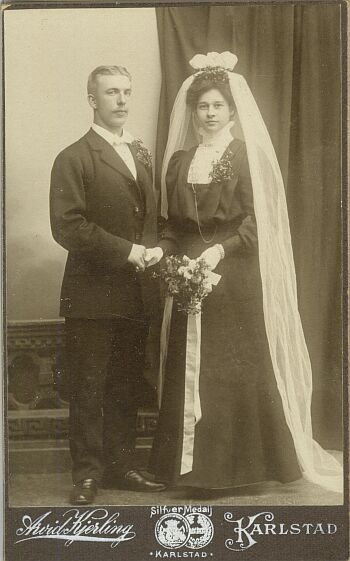
Another reason for the black wedding dresses was that they were practical. Many women would wear their best dress for their wedding, and that dress was often black. Black fabric was more affordable and easier to come by than white. According to this article about frontier weddings, dark or patterned fabrics were also preferred because stains or dirt wouldn’t show like they would on white. If you could afford a white dress, you probably could afford a laundress, and that wasn’t just everyone. The white wedding dress came into fashion for the general public after Queen Victoria wore one in 1840. Here is a brief article about that, along with some photos.
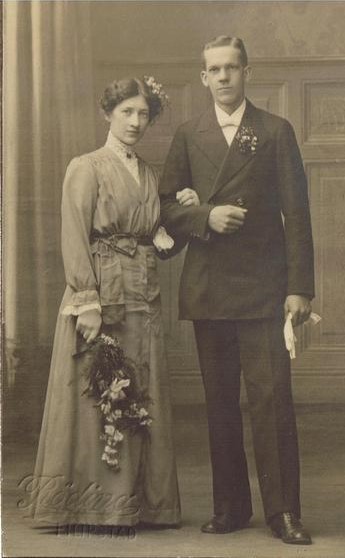

The bride on the left is wearing a pretty dress that could be brown or maybe blue. Maybe it’s just the tint of the photo, but I envision the on the right as being pink. The reason I don’t think it’s white is that there is a bit of contrast between the dress and what looks like a white blouse the bride has on under it.
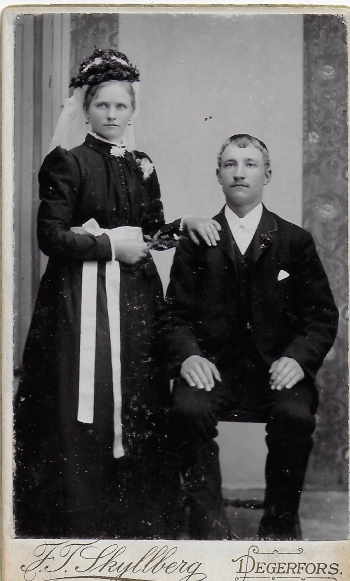
I found these on the Swedish Roots website, but you can also see photos like this on Pinterest. People even buy random CDVs and cabinet cards at antique stores or estate sales and sell them online on sites like eBay and Etsy.


Here are portraits of two unknown couples from Filipstad, Sweden, both taken by the same photographer. The pair on the left caught my attention because they were holding hands, a fairly uncommon pose for that day. The bride looks a little uncertain though. I like the dress on the right because of the trim on the bodice. If you look closely, the groom is almost stepping on the hem of his wife’s dress.

According to Swedish Roots, this is Per and Selma Johansson. You’ll notice they both have on white gloves, and Selma seems to be smiling a bit more than some others. You’ll also notice they are standing pretty far apart.

This was labeled “Karl Olsson and his first wife, Maria.” I like Maria’s dress because of the pleated white bodice and the trim that almost looks like rickrack. The collar looks like it would have been uncomfortable, though. Notice they each have on white gloves.

Speaking of white gloves, the groom has taken his off for the picture. This couple was identified as John and Edla Landin. Landin is a name that figures into my family to some degree, as for a time the pastor of the Swedish Lutheran church in Ludington was J.A. Landin. There was also a Swedish missionary family in China named Landin. I read about him in this post from Thérèse Amnéus’s blog. I haven’t run across that many Landins, on Ancestry or anywhere else, so who knows if they could all be distantly related? (Note: I know this logic doesn’t work with last names like Johnson, because in those days all you needed was your father’s name to be John, and you were Johnson. See “What’s in a Name?” for more info on that.)
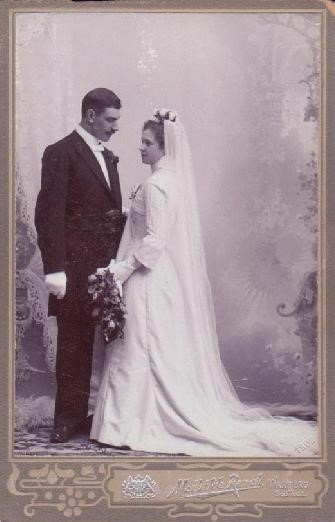
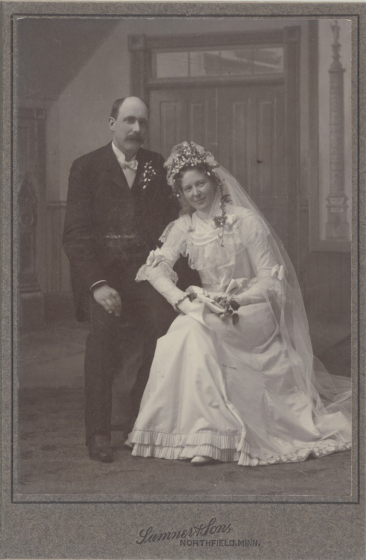
These two portraits are rather unusual based on what I’ve found online. The couple on the left are looking at each other, and they are standing pretty close together. On the right, the bride is actually leaning in toward the groom and is resting her arm on his leg. As we have already learned, the white dresses could be an indication of wealth or position in society.
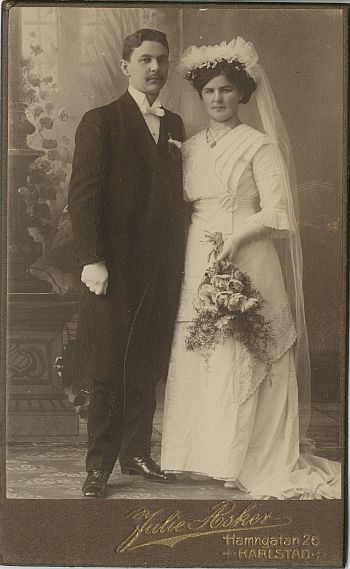
These two are standing a little closer together than normal, as well.

I read somewhere that wedding portraits were usually taken at a studio after the wedding, maybe not even the same day. This could explain why the brides aren’t always holding flowers in their wedding pictures. This article explains that the bridal bouquets were often made of dried flowers instead of fresh. In those days, depending on where you were, fresh flowers were not readily accessible. I’m guessing that the bouquet in this photo could be one of those.
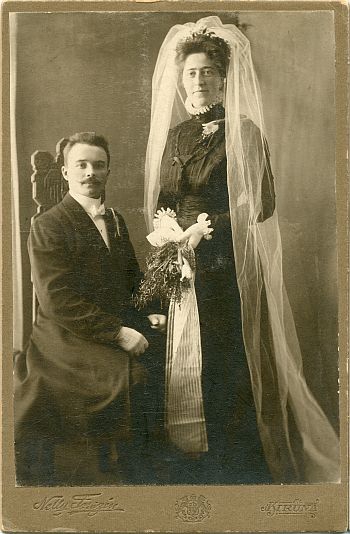
According to Swedish Roots, the name “Israelssons” was written on the back of this photo. It could just be me, but it seems like the groom may be seated to take away from the fact that the bride is taller than him. Mrs. Israelsson’s bouquet looks like another example of the dried flowers mentioned above.
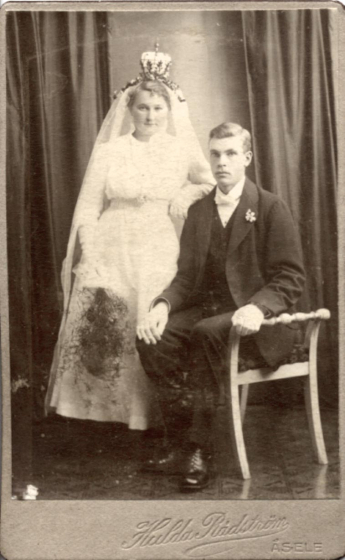
In this portrait from Lapland, I think the bride’s tiara is a bit “overdone”. Her bouquet looks like it’s mostly ferns, maybe another dried arrangement.

This is Anders and Hulda Svensson. Like most of the bridal couples you’ve seen here, they look pretty serious. There are a number of reasons for this, not the least of which being that they felt it was undignified to smile for a photograph that may be the only one you ever get taken of yourself. Mark Twain is quoted as saying that people shouldn’t smile for photographs because nothing would be worse than “to go down to posterity than a silly, foolish smile caught and fixed forever”.

The expressions and body language of some of these vintage pairs seems to go beyond the typical “dignified look” to real unhappiness or apprehension. This could have been for a variety of reasons.
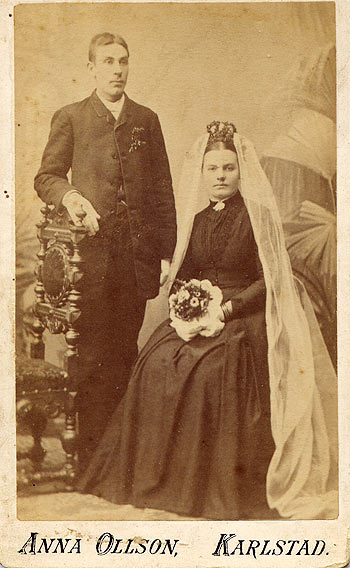

These two couples (especially the brides) both look a little less than joyful, but then how do we know the photographer hadn’t said something irritating right before snapping the picture? However, I have read, and I think most of us know, that a lot of marriages back then were less for love than for some practical purpose. I can see the possibility of this in my own family history.

I don’t have their wedding picture, so I have no facial expressions to go on, but we know from my great grandmother Petronella’s story that she came to the US to marry a man who was only an acquaintance. He had written to friends in Sweden asking if they knew anyone who would be willing to come to Minnesota and marry him, and Petronella rose to the challenge. Clearly this was more of a practical decision than a romantic one, and she must have felt at least some apprehension going into it. Still, she always told my grandmother she was happy with the man God gave her.

This is my great grandmother, Charlotte Nelson, in her wedding picture with her second husband, Stengrim H. Detlie. Her first husband, Nels Nelson, was my grandma Edla’s father. He passed away in 1900, leaving Charlotte with three young children from the ages of four years to seven months. Stengrim and Nels had been friends, and while I’m sure Charlotte and Stengrim had a loving relationship, there’s really nothing to suggest that their marriage in 1903 wasn’t born out of some aspect of practicality. Stengrim needed a wife, and Charlotte needed a husband to help her raise and provide for her children. I feel like Stengrim stepped up and in a way, honored his friend Nels by taking on the responsibility of his family. Charlotte and Stengrim went on to have two more children together as well.

There is a possibility that this is Britta Helena Larson, who married my great grandfather, Nels Johnson, in Ludington, Michigan in 1883. She died of tuberculosis in March 1887, and Nels was left with two children: Emily, who was 3 years old, and John Alfred, who had been born only 8 months before. In a letter written to me in 1977, my great aunt Anna told me that her mother, Anna Caroline, had been working for the family, taking care of Britta and the children while she was ill. In December 1887, roughly ten months after Britta’s death, Anna and Nels were married. Like Charlotte and Stengrim, I’m sure they loved each other, but it was likely the marriage did not originate from romance alone. Aunt Anna said they fell in love after Britta’s death, but it could be they did the practical thing and grew to love each other after marrying. Their lifelong dedication to their marriage in seen in the fact that, counting Emily and John Alfred, they raised ten children (two whom they lost to death before the age of five) and one grandchild.

Speaking of practical, these couples apparently chose to have a double wedding. Could the brides be sisters, or were the grooms brothers? It looks to me like the brides’ dresses are identical, as well as the suits the grooms have on. None of them look like twins, but then they could have been fraternal. Or, since they aren’t related to me in any way that I know of, maybe it’s really none of my business and I should keep my opinions to myself.
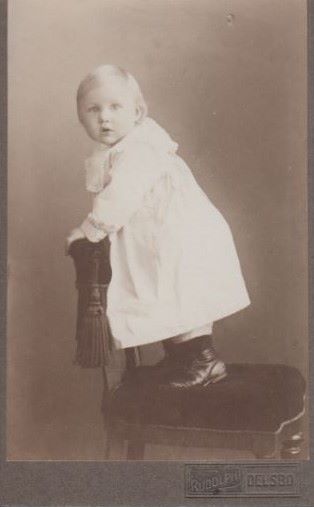
Or maybe I should start a new post about how, after they got married, people let their toddlers (with high top button up shoes) stand by themselves on chairs at the photography studio!
 Nana's Whimsical World
More wonderful history – thank you. I remember my mother talking about her “Grandpa Detlie,” but I never knew his first name was Stengrim.
Glad you enjoyed it! I remember never really knowing who “Grandpa Detlie” was, although I heard the name a lot. Did you know he was Norwegian?
Simply love this post! I am very much into finding out about the 1800s and had not gotten to the wedding dress part yet – very thankful for your thourough research! It’s funny how they many of them look like they are rather going to a funeral than a wedding, when seeing them with the eyes of today’s society. Makes me think about how the Chinese wear white to funerals – a colour that we connect to weddings. It’s awesome how they were so practical and lived sustainably – seeing to it that the dress would be worn many times – we should certainly think about that today as well.
And thank you for the referral to my blog – we did have such a good time discussing and researching the Landins 😁
Also, love the wedding photo of your great granny Charlotte. She looks beautiful in her shirt with the flower arrangement and that cute bow, or hat on her head – what is it – it does not look like a veil?
Will certainly come back to this post again!
I thought you would like this one! I looked at the picture of Charlotte again and I think it’s a white ribbon/bow in her hair but I could be wrong. 🤔 I wish there was a wedding photo of her and my grandma’s father Nels. (If there is, I haven’t found it yet.) But being only 7 months old when Nels died, I guess really Stengrim was the only father she ever knew.
I did, very much! Yes, I suppose when you are that young, the father that is there is the one you will call dad. But she might have been curious about her biological father – I would have been.
Yes, I would have been too! One of my cousins commented that they used to hear about Grandpa Detlie but didn’t know his first name was Stengrim. I remember hearing about Grandpa Detlie when I was growing up, and what I find amazing is that it didn’t really dawn on me how he fit into the family until the past few years! And me being the “family historian” so to speak! 😂😂I don’t remember anyone ever referring to Grandma Detlie, but Charlotte died in 1937, when my dad was about 5, and Stengrim lived to be 96 and died in 1968.
More wonderful history – thank you. I remember my mother talking about her “Grandpa Detlie,” but I never knew his first name was Stengrim
Very interesting how family and others were portrayed back in the “old days”. I love your post, thank you 🫶
Thank you for the compliment! I’m glad you liked the post. I think it’s so fun to look at all the pretty dresses and wonder about the people’s lives. 😀
Oh, that was really interesting. Black looks rather nice with the white of the veil etc. and so much better to wash! I know it used to take a very long time to take photos, so I can see sometimes they smiled and sagged a bit.😉
That’s true, too. And they could have been uncomfortable in some of those outfits!🤔
Hi Debbie,
When we got married, my sisters were my maid of honor and bridesmaids.
They made their own dresses or my older sisters made my younger sister’s dresses. They got to pick out any styles and fabric they liked, something they would wear again.
Love, Eileen
That’s awesome! I remember being at your wedding too😀🥰
Interesting history about the black wedding dress! I used to collect cabinet cards and use them in my collages. Enjoyed seeing all the different wedding photos.
I’m glad you liked it! I still find myself looking through old wedding photos online even though I finished the post already.