A Look at Sailor-Inspired Clothing
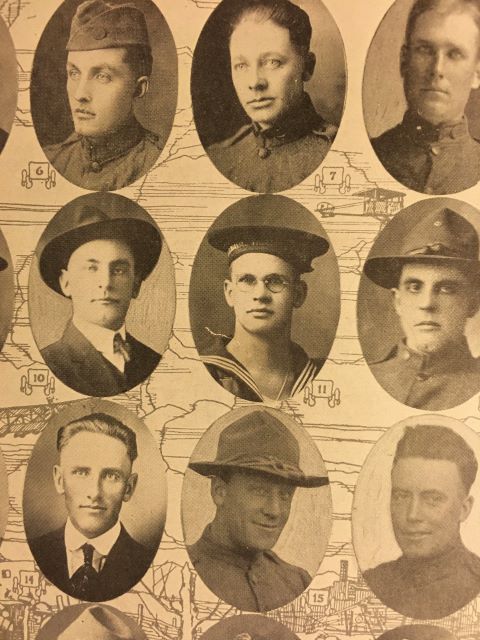
George Anderson, my maternal grandfather, is seen in the center of this photo from 1918.
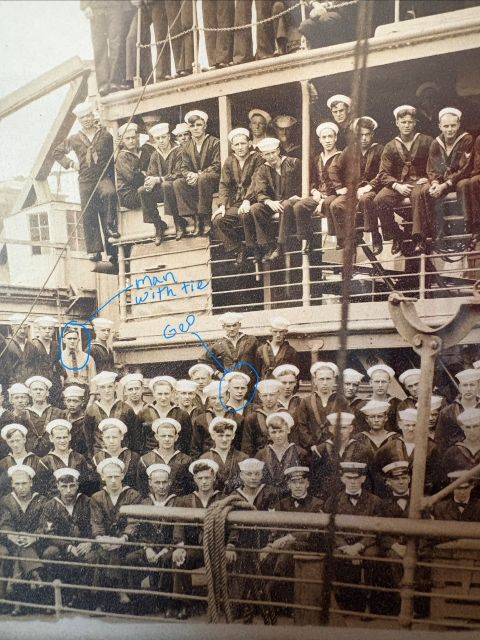
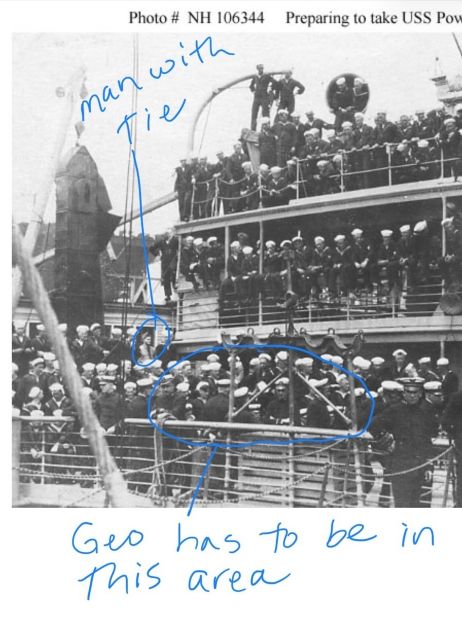
Left: In this close up from the 1919 crew photo of the USS Powhatan, you can see George (circled), as well as a random man with a tie. I use the man with the tie to locate George in the photo, because he is the seventh sailor to the right of him. Right: In researching the USS Powhatan online, I found some pictures of when they were getting ready to take that exact group photo. I’ve circled the man with the tie as well as the area where I think George would have been, milling around with the other sailors waiting for the order to get in line. There are more ways you can tell it’s the same photo shoot, including the sailor above the man with the tie, standing on a railing with his hand on his hip. Strangely, the website where I found the Powhatan photos, Shipscribe.com, didn’t have a copy of the finished product that I have on the mantle in my front room. This topic will probably become a post in itself, but I’m including the pictures to show the authentic sailor suits.
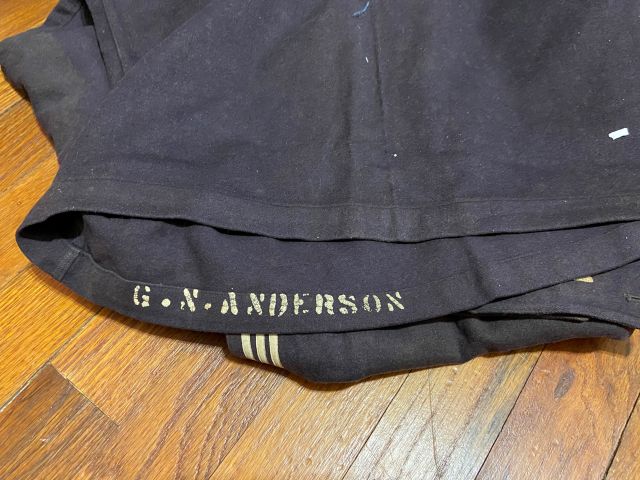
I actually found George’s uniforms while clearing out my moms’ house after she passed away a few years ago. I sent them to my aunt June because she is his oldest daughter. I think the above photo was the shirt for the blue uniform. I apparently didn’t lay it out flat to photograph like I did the white one, but I wish I had.
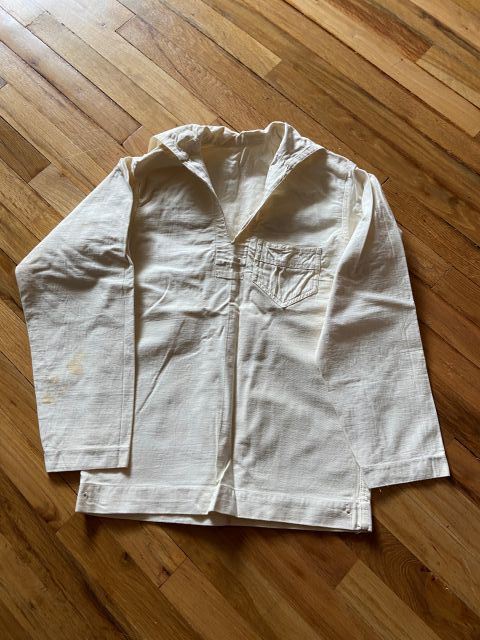
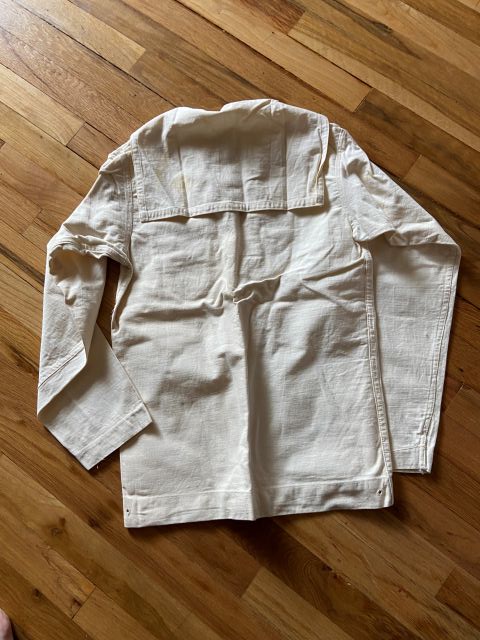
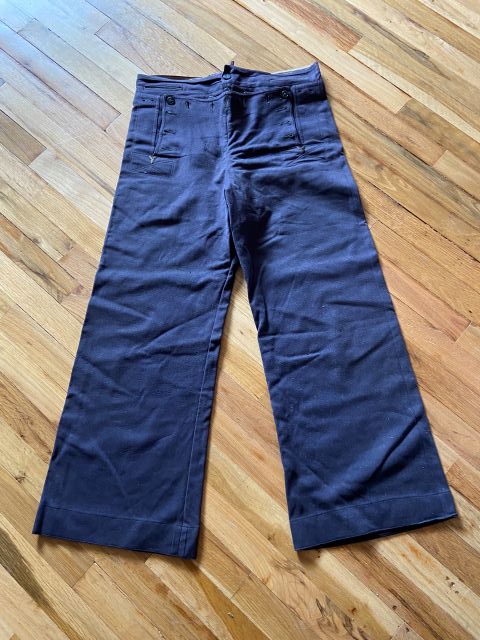
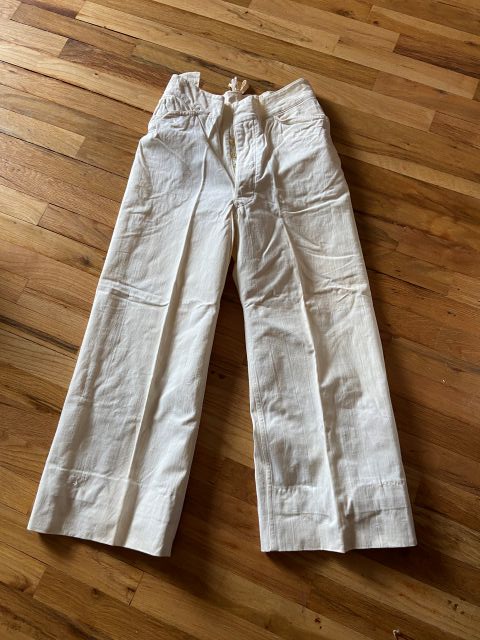
I also wish I had measured the waistbands of the pants, because they were extremely small. I could tell by looking that George, when he was twenty-one, had a smaller waist than I probably did at that age!

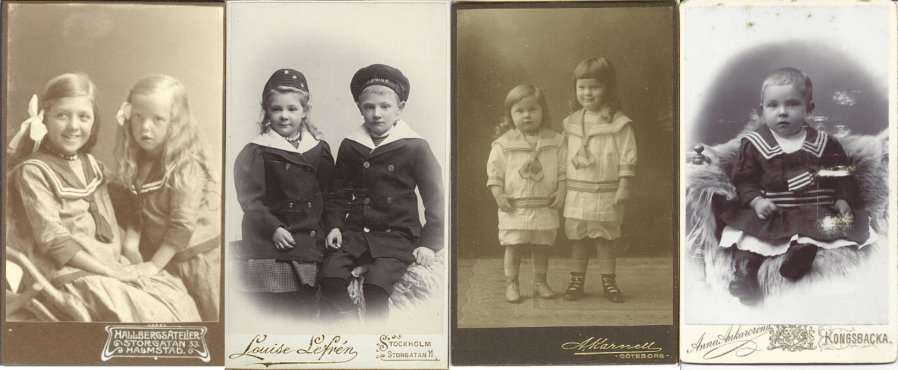
In other sailor news, you’ve seen Inez and Lester, who were my mom’s cousins. According to her, this was after they had tried to cut their own hair. Neither of them looks very happy, but their little sailor suits were cute all the same.
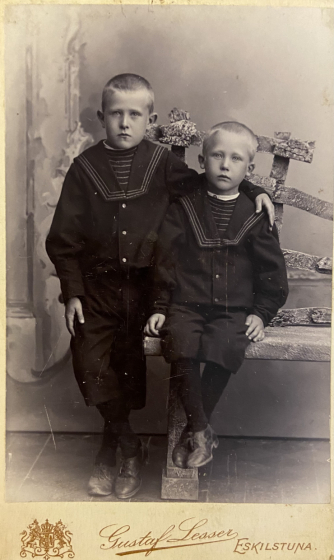
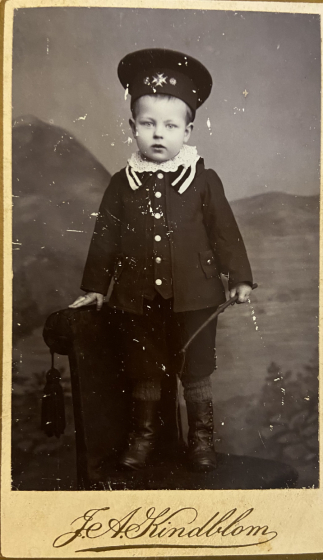
These are from my great grandmother Petronella’s carte-de-visite album. The boy on the right is unknown, but I recently found out that the ones on the left were Martin and Albin Andersson. Their mother was Inga Andersson, Petronella’s sister. Albin died tragically in 1915 at the age of 23, when he fell from a two-story window in Hartford, Connecticut. You can see two newspaper screenshots about this incident toward the end of “Faces from the Old Country”. Martin never came to the U.S., and my grandmother wrote that Inga never got over the loss of her son in America.
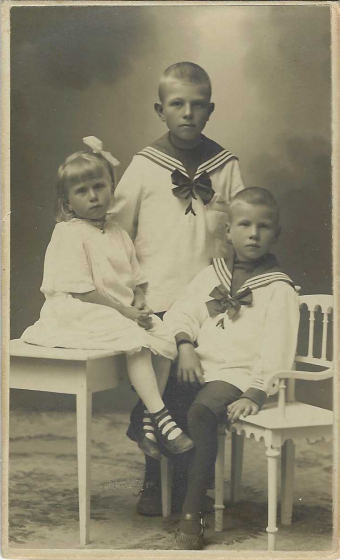
If you’ve read “Seeing Double, Part 2”, you’ve seen these unknown children from the “Swedish Roots” website. That’s where I announced my intention of doing a post on the sailor suit style that was so popular for kids in Victorian and Edwardian times. You probably know I’m somewhat obsessed with Swedish Roots, partly because of all the amazing clothing and hairstyles you can see there. That’s where I got most of the photos for “These Boots”, “The Higher the Hair”, and “Mad as a Hatter”. But as always, I like to research my information at least a little bit, so I looked into how the sailor style was introduced and what made it so popular.
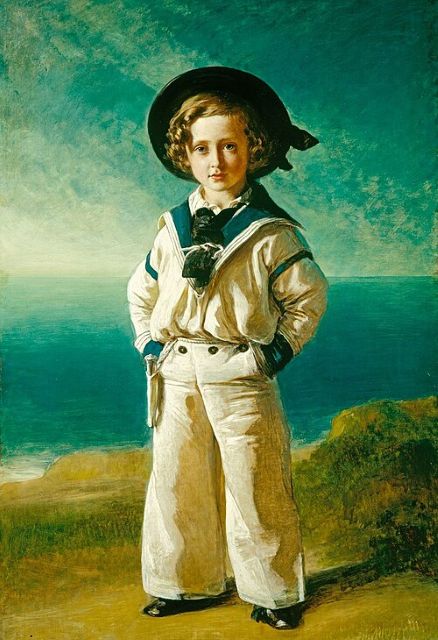
As with so many things in the world of fashion, the child’s sailor outfit was introduced by Queen Victoria. According to this article from “Queen Victoria Roses”, it was 1846 when Queen Victoria commissioned a sailor outfit for her oldest son, Albert Edward, the four-year-old prince of Wales. She wanted it to be patterned as closely as possible after the uniforms worn by the Royal British Navy of the day. The outfit was a smashing success, and the style quickly caught on around the world.
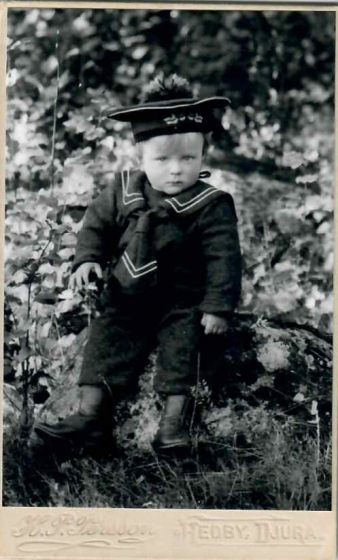
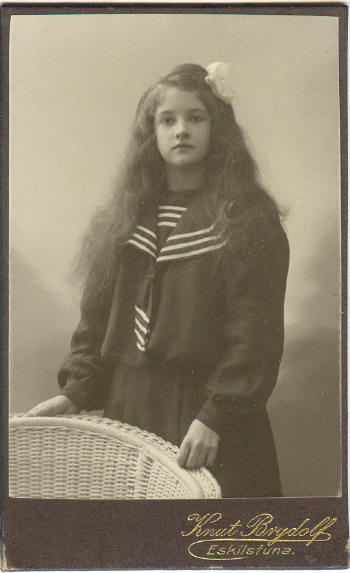
Above: A small boy and a young girl from Swedish Roots. There is a lot of good information in “Sailor Suits in Fashion”, Published in August 2022 by the European Fashion Heritage Association. Following is a quote from that article: “In the 1880s, advertisers began marketing sailor suits as fashionable garments. For boys, this consisted of a middy top (a loosely fitting blouse with a collar similar to the one found in sailors’ uniforms) with shorts or long trousers, while girls would wear the top with a pleated skirt.” The article includes quite a few good photos and illustrations. It also shows how the style began to be used for adults as well.
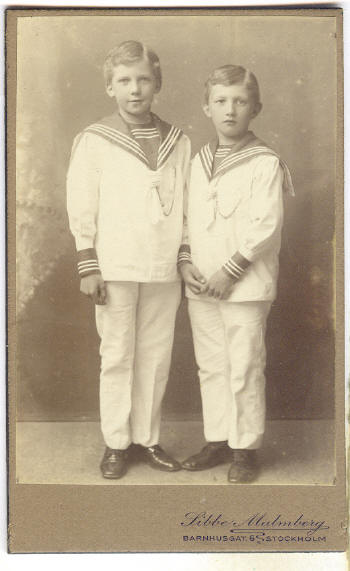
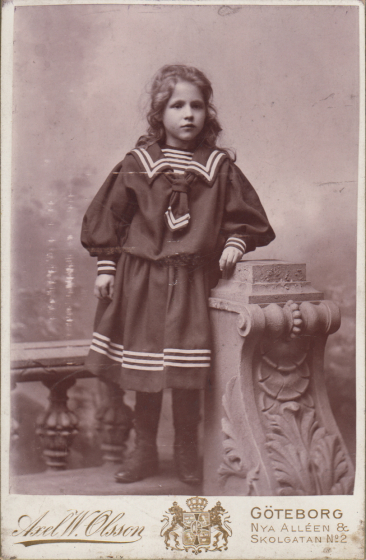
From what I gather, the child’s sailor suits could be (what I’m assuming is) blue with white trim or the opposite. You can see that there were different collar patterns and the outfits in general came in many varieties. I read that at first, the sailor style was worn primarily by the “well-to-do” classes. As you may remember, this was the case for white wedding dresses, also introduced by Queen Victoria. (See “Vintage Weddings”.) After a while, like white wedding dresses, the sailor style was available to and worn by every social class.
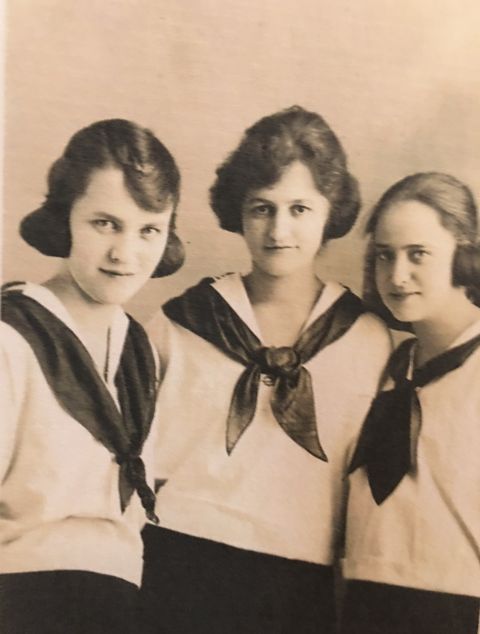
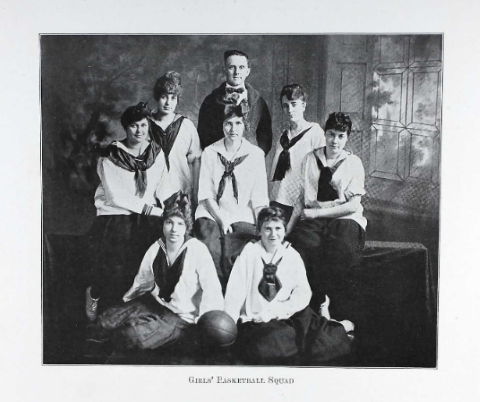
The sailor outfit also became popular for school uniforms, and for ladies’ sports. (In the article “Sailor Style Part 1: A Style is Born”, you can see some great pictures of ladies’ sailor styles from the 1800s to the 1920s.) Above, the photo on the left shows my grandma Edla (center) with two friends who are unknown to me. I’m not sure of the year, or whether it had anything to do with school. On the right, you can see the 1916 women’s basketball team at Augustana Lutheran College in Rock Island, Illinois. I found the yearbook on Ancestry while looking for my grandpa Emil, who was there that year. Emil was on the men’s basketball team, but they had on considerably less clothing than the ladies, so I’ll refrain from posting that photo here. Besides, their uniforms didn’t have a sailor motif.
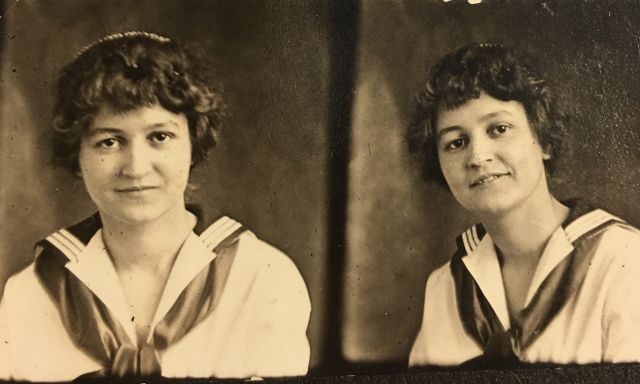
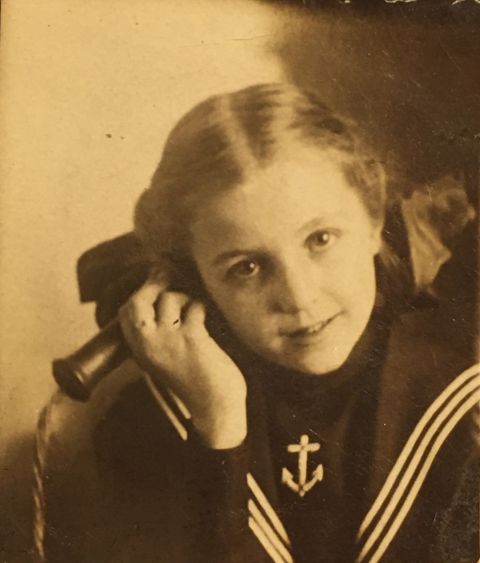
Two more pictures of Edla, from what appears to be a photo booth, and one that I think might have been her sister Alma, or possibly her half-sister, Peggy.
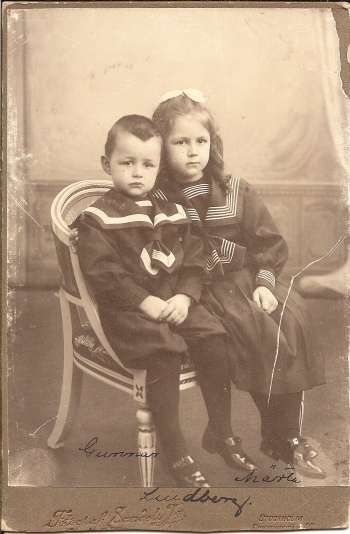
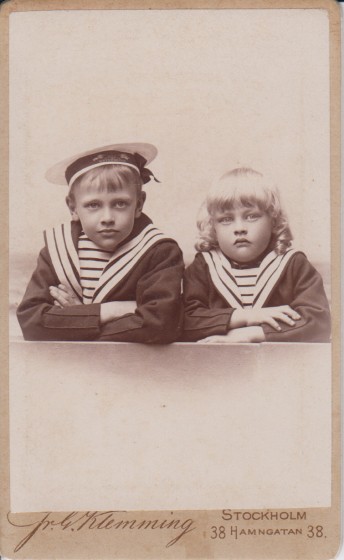
The children on the left were Gunnar and Marta Lindberg. The ones on the right are unknown. They all look pretty serious, as if they weren’t in the mood to have their pictures taken, or the photo session was dragging out for too long.
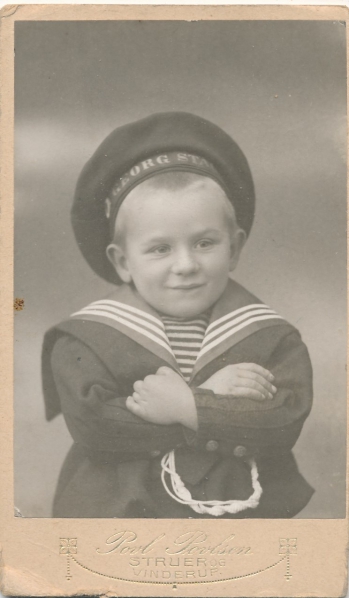
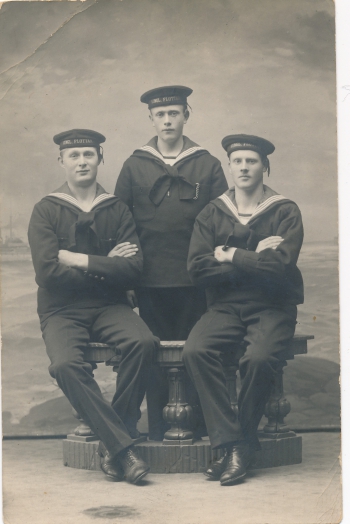
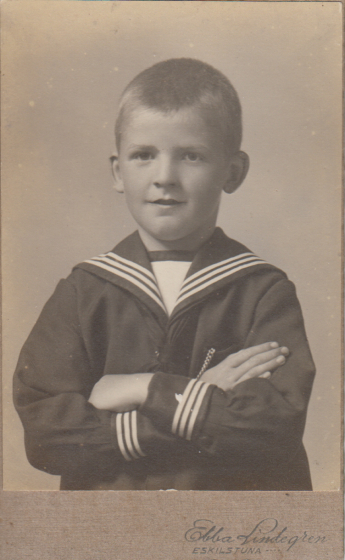
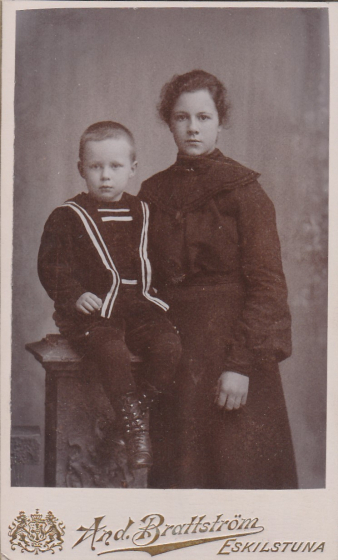
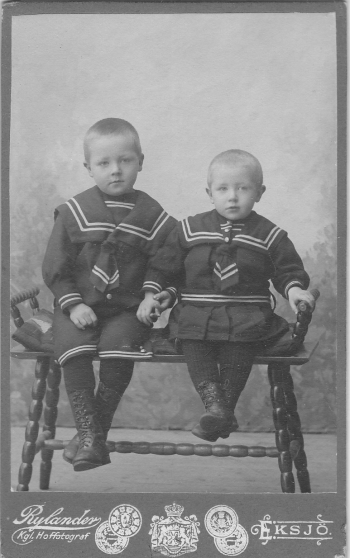
You’ve got to love these little guys, from two different studios in different towns, yet striking the same pose. I’m guessing they were imitating a common photography pose used by real sailors like the ones in the center.
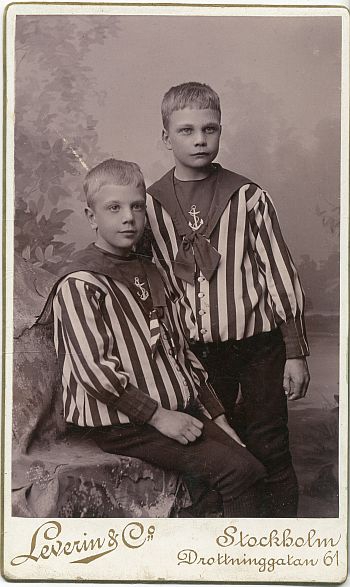
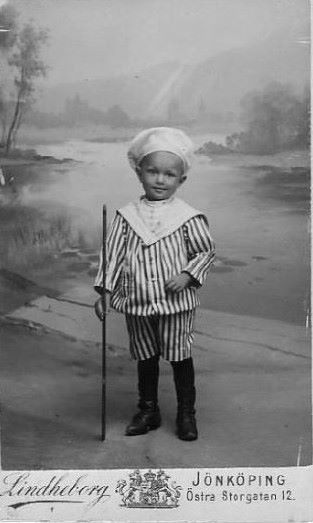
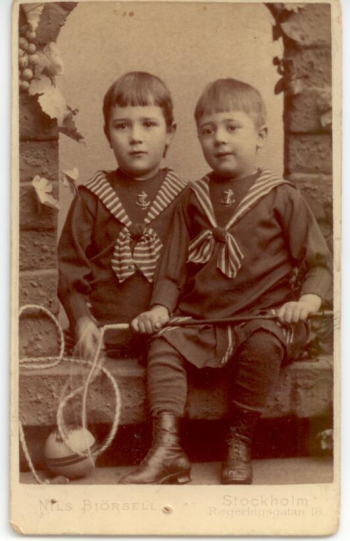
I don’t want to sound judgmental, but the outfits on the left say “overkill” to me. The center one isn’t so bad, but not really my style. The striped ties on the right are cute, and if you notice, they’ve been cut differently, though apparently from the same fabric. Did the person who made the outfits run short on striped fabric and have to lay the pattern out differently for one of them? Or was it done on purpose? Are they twins, maybe?
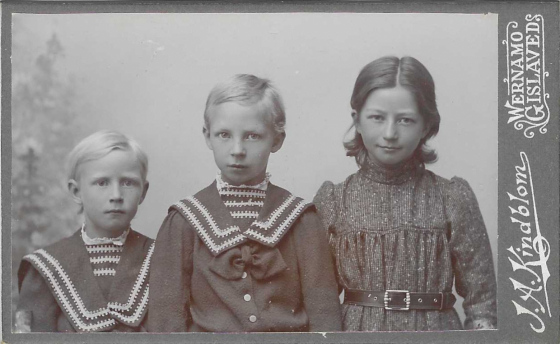
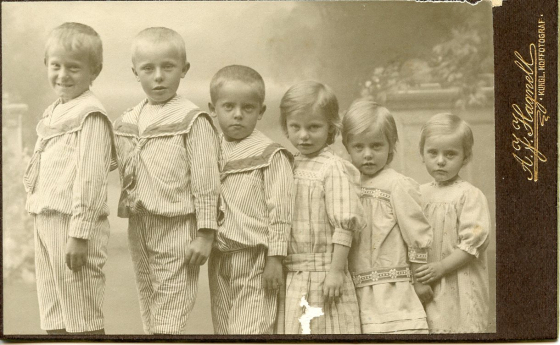
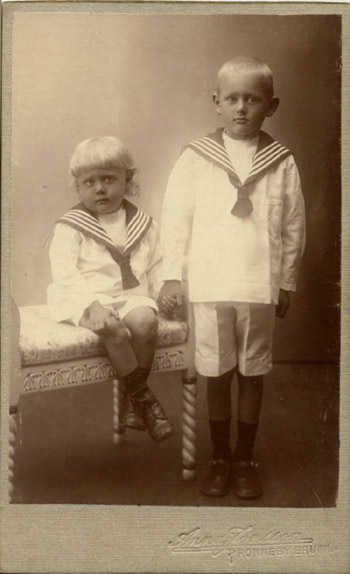
In these two, it looks like only the boys got to wear sailor suits.
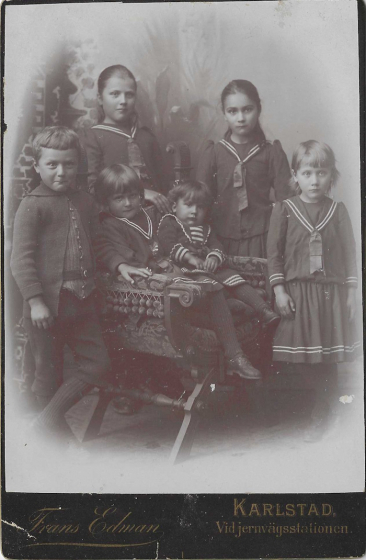
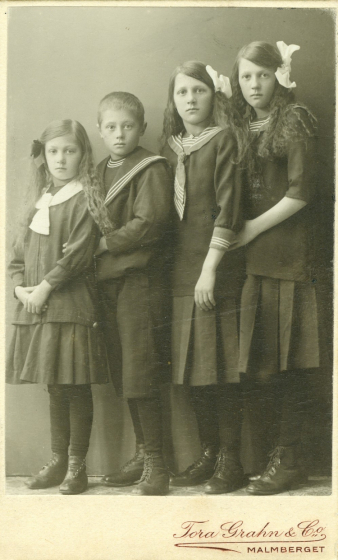
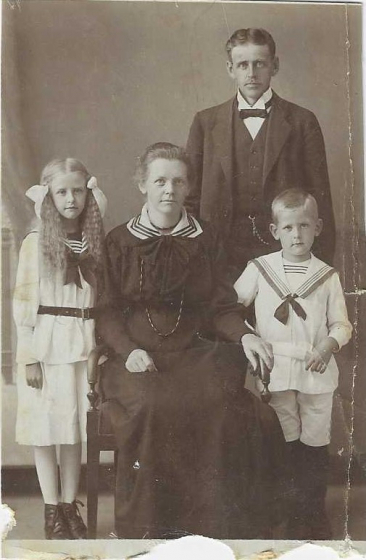
Everyone got to wear one in these families, except the boy at the far left. Did he not have a sailor outfit, or did he refuse to wear it? Or was he a cousin whose mom didn’t get the memo?
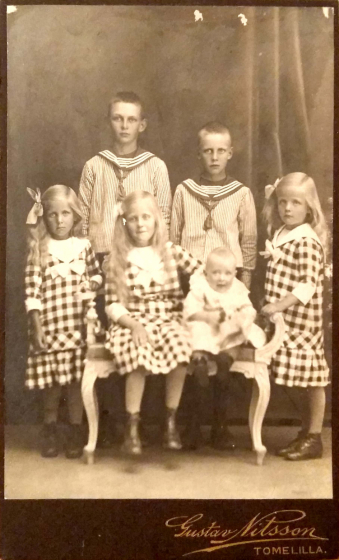
In this one, the boys have on pretty traditional sailor shirts, and the girls, while not in actual “sailor suits”, do have a “sailor-ish” motif to their collars, which I thought was creative.
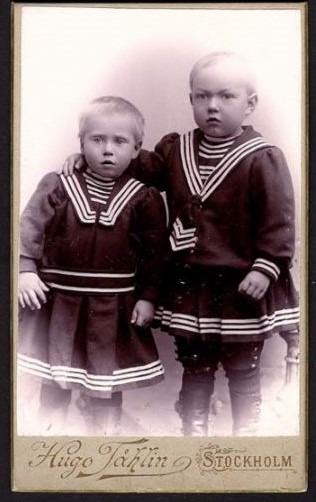
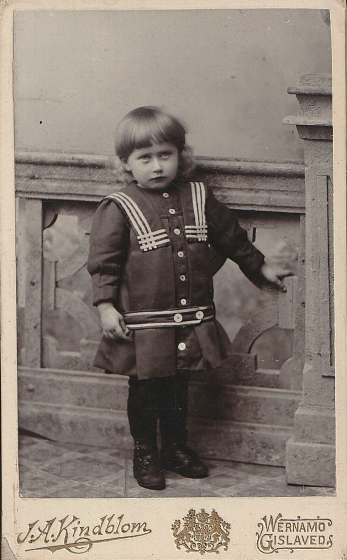
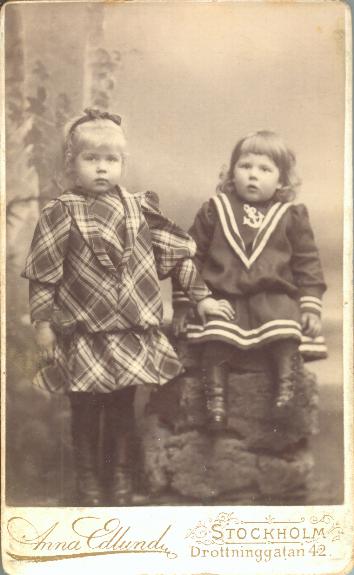
Speaking of boys’ and girls’ outfits, you may remember the photo on the left, labelled “Elis and Walter”, which I used in “Mad About Plaid”. In that post I explained a little bit about how and why very young boys often wore skirts in those days. Elis and Walter both have short hair, but so did a lot of the little girls. Conversely, a lot of the boys (including famous people like Franklin D. Roosevelt) had their hair pretty long as toddlers. For the center photo, I’m guessing boy, but I could be wrong. The children on the right were labelled “Ruth and Hjalmar Rehn”. Hjalmar is a boy’s name, but if you were only going by the hair and the dress, you might mistake him for a girl.
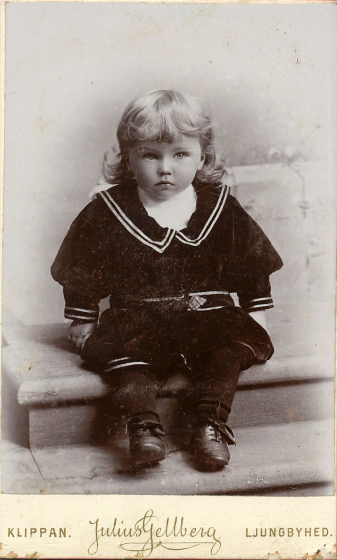
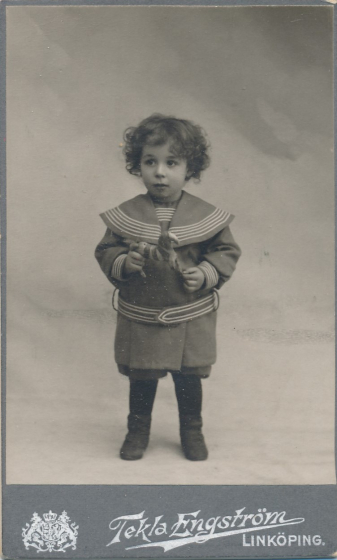
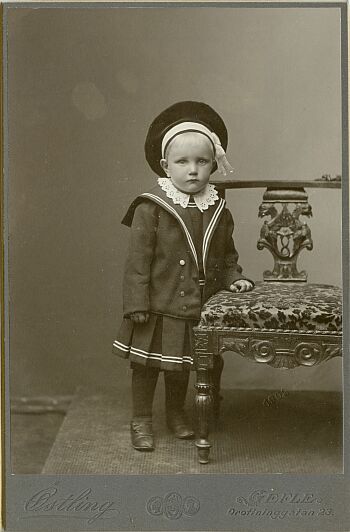
Unless you have names like Ruth or Hjalmar to go with a picture, it may be hard to tell who exactly you are looking at. Since these three were listed as “unknown child” on Swedish Roots, I’ve labelled them as “sailor suit” and “adorable little kid”, and “boy or girl”.
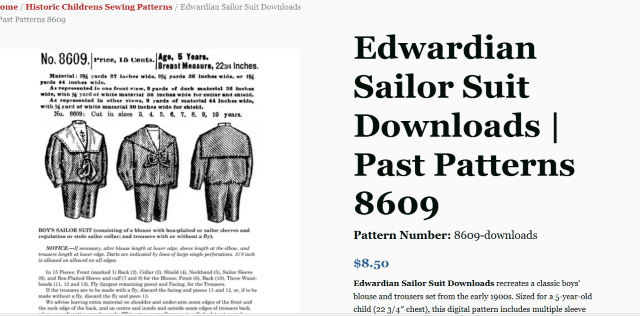
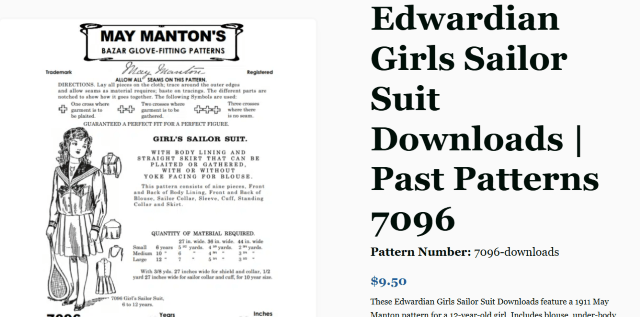
So where did they get all these cute sailor outfits for kids? I’m sure you could buy them ready made, but I think a lot of people had them made or made their own. And what if you wanted one today? I found a website called Past Patterns, where they sell reproductions of all kinds of authentic historical clothing patterns. If you are really industrious, you could order a pattern and make your child a really “original” sailor outfit. You just have to search the era you want and then the type of outfit. Here is a quote from the info about the girls’ pattern above. “This Edwardian Girls Sailor Suit was advertised in The Evening Journal, Wilmington, DE (August 7, 1911) and The Wilkes-Barre Times Leader (August 8, 1911). It was praised as “the ever useful sailor suit” and described as ideal for both warm and cool weather garments, adaptable to washable cottons or heavy woolens.”
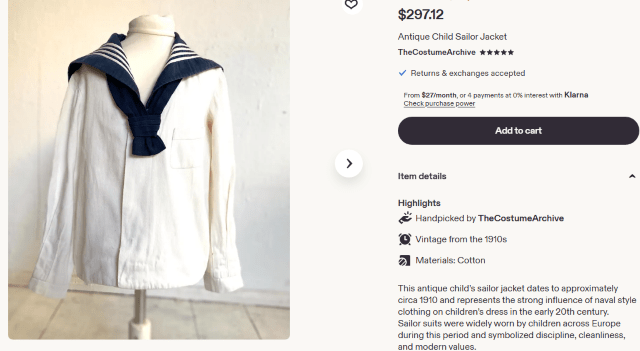
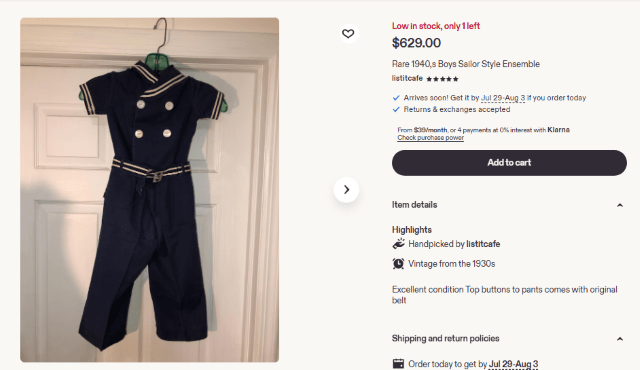
If you want to be even more historically accurate, you could go online and order an actual antique sailor outfit from places like Etsy or eBay.
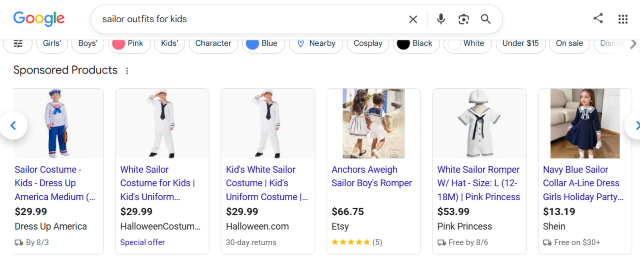
While you’re browsing online, you could just order a modern one. I noticed that more than a few of the results were supposed to Halloween costumes. I don’t know why that should seem sad to me, but it does.
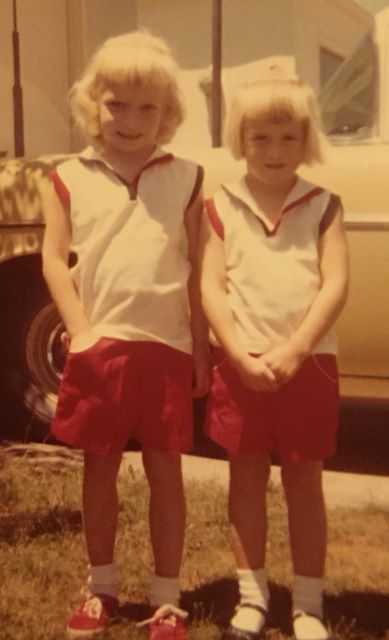
I discovered that there is a difference between “vintage” and “antique”. When I used “vintage” as a search term, I came up with outfits from the 1950s through 1970s. Which I guess is okay, but it’s not the same, especially when you realize you are now “vintage” yourself. (Speaking of vintage, can you see our dad’s 1957 Chevy Bel Air behind us? He always said he wished he had never sold it.)
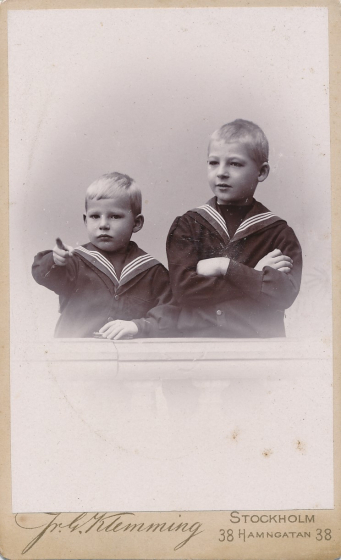
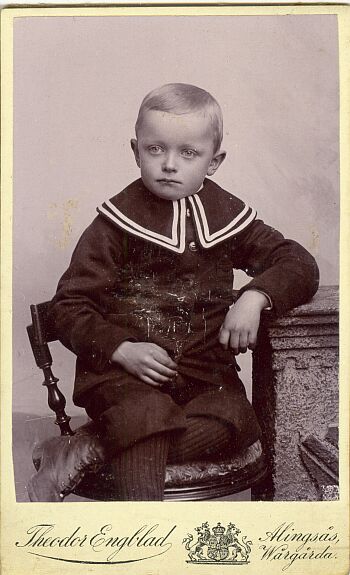
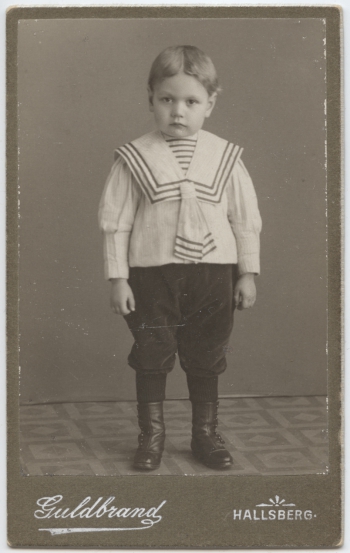
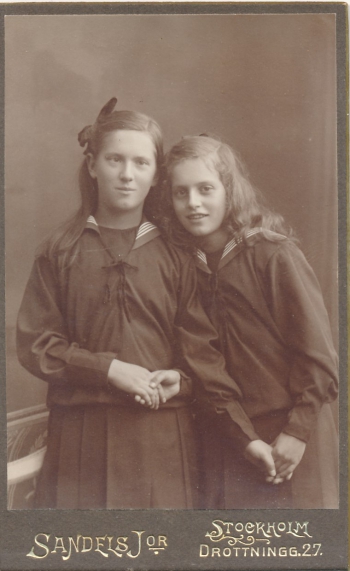
Any way you look at it, sailor suits were an integral part of children’s fashions for decades. The many variations that were available made it possible to dress your child in a sailor attire without necessarily having them look like everyone else. Judging by the sheer number of photos to be found on the Swedish Roots website alone, there must be thousands more on other sites as well. But in case you don’t have time to do your own research, just remember, I spend hours on this stuff so you don’t have to!


Love the photos and the history! “Vintage”!!!! Too funny!
Lol thanks ! 😂
Brilliant! That was so interesting. Those things that kids had to wear back then. I do quite like the top part for girls/women to wear for summer though. 🤔😊
Thanks, I’m glad you liked it! My problem was that there were so many pictures to choose from and I kept finding more. So it was like “Okay just one more…” 😂
Great photos and love those vintage memories,
Thanks, Sandra! 😀
I was looking for Popeye! Why do we save our old uniforms? I have mine–not navy–and could not fit into it to save my life!
Believe it or not, the idea occurred to me to put him in there! 😂I still have my 8th grade graduation dress and there no way it would ever fit me now!
Think I pressed the wrong button so I try again. I did not see Popeye! Why do we keep our old uniforms? I have mine but could not fit into it to save my life! (not Navy)
Lol I figured that was probably you, since the comment came in at the same time as your like. I answered it anyway 😂 What I can’t believe is that my mom had those uniforms, including the hat, folded up in a not very big plastic container for all those years and I never knew she had it. Or if I did, I’d forgotten. As the “family historian” it seems like I would have known it was there. 🤔
Who knows or remembers what is inside those tucked away plastic bins
Very true! That’s a blog post in itself!
And why are we keeping it?
I’ve always loved the children sailor outfits. Both kiddos had them. ⚓️
What a great post with so much interesting information! I love how your family still has the navy suit, and the photographs with Geo on the vessel. The kids in navy attire look incredibly cute, I can totally see that it became a trend to dress them like that. Sometimes you still see this kind of navy style on both children’s clothes and for grown women. Not so much for adult men, though…
That’s true, it does seem to be mostly women and children who wore the style. 🤔 I’m glad you enjoyed reading the info in the post, I thought it was a fun one to write. I wish I could actually see Geo clearly in the pictures of the Powhatan from online, but at least I’ve narrowed it down to the general location where he probably was. He was a ship’s cook, and there are pictures on that website of the Powhatan’s kitchen, but with nobody in it. It was cool seeing the photos and thinking, this is where he would actually have been spending time. So many interesting things to think about!
I can imagine you did so much research for this post and it really comes through that you enjoyed it! How great that there are photos of the kitchen on the ship – that certainly puts Geo in a concrete surrounding. I can imagine it must have been difficult and required quite some skill to be cook at sea, and with that many to feed! Impressive!
Chaplin: “Yo-ho, yo-ho!”Charlee: “That’s what a pirate says, not a sailor.”Chaplin: “Well you know, all pirates are sailors, but not all sailors are pirates, right?”Oona: “Do not get Oona started on pirates! They are the traditional enemies of ninjas!”Charlee: “I don’t think that’s actually true.”Oona: “OONA DOES NOT THINK YOU ARE A NINJA, SO HOW WOULD YOU KNOW???”
Foster: Whoa guys! Best not to get Oona started on pirates! Or ninjas!
Panda: Umm, I think they already did…