
Errors in the 1920 Census
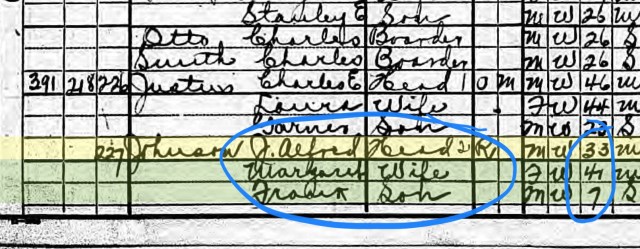
I’ve told you I had started thinking there never was a Frank Johnson, the 7-year-old son of John Alfred and Madge. In “Finding Frank (Or Not)”, I left you with the thought that maybe Frank was really there, but the census taker only assumed he was Madge and Alfred’s son. After all, to be seven years old in 1920, he would have to have been born six years before they even got married.
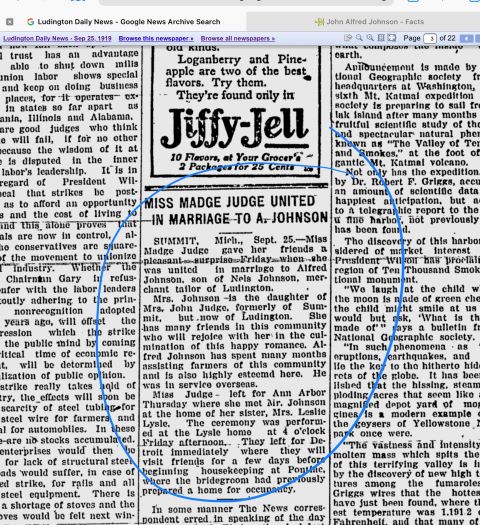
There’s nothing on Ancestry to suggest that Madge already had a son by 1919, even though she was about ten years older than Alfred. Nor is there any indication that Alfred could have had Frank by a previous relationship. I’m not naive enough to believe that there couldn’t have been a child born out of wedlock in my family, because there was at least one that I know of, in 1910. In that year, Michigan birth certificates had a place to enter whether the child was “legitimate” or not, and this one actually has “No” written in the box. To me that seems so sad; why should a child have that kind of label follow them forever? It would have been enough to enter the father’s name as “unknown” if it came to that. However, the child wasn’t Frank.
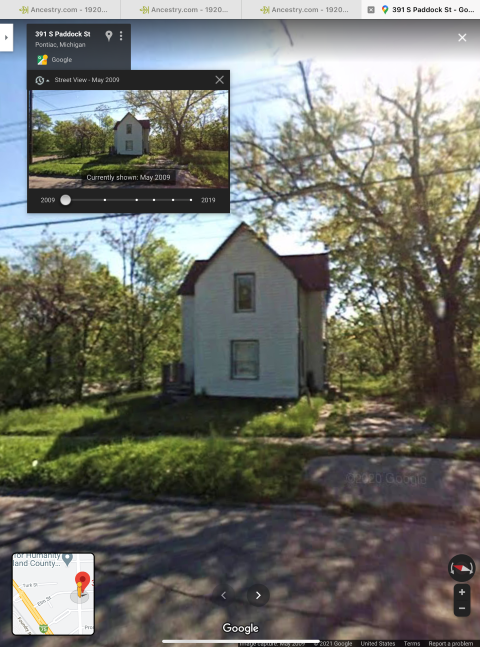
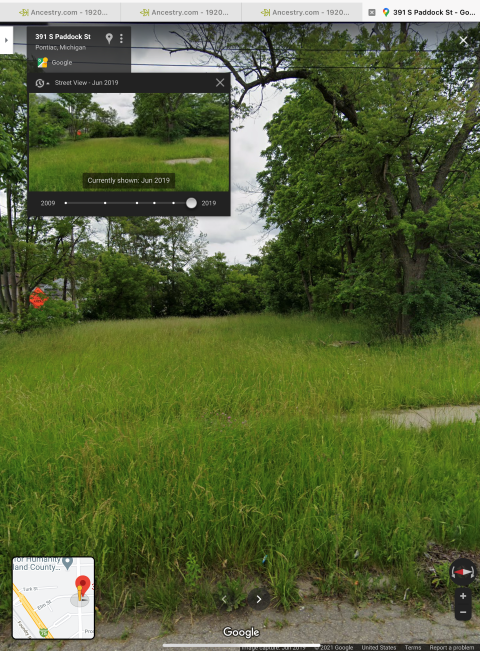
This is 391 S. Paddock, the house where Madge and Alfred lived when the 1920 census was taken. In 2009 the house was still there, but by 2019 it was just a vacant lot. It doesn’t look like it was all that big, but from the census you can see that the house itself was owned by a Charles E. Justus and the Johnsons were apparently boarders there. This is all explained in “Finding Frank, Part 1”, so I won’t go into all that here.
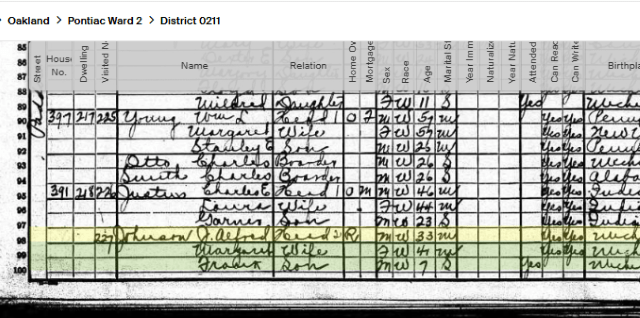
It may not have been clear in the first screenshot of the Johnson family’s 1920 census report, but Frank was on the very last line of the page.
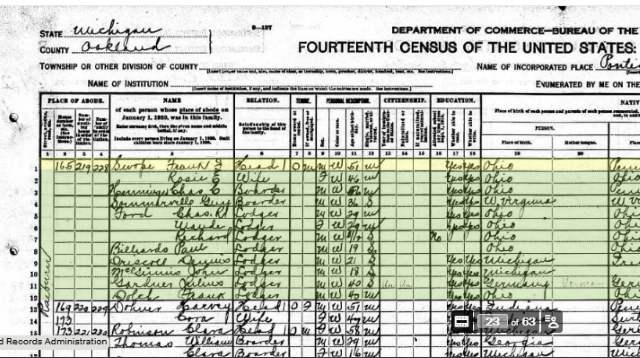
If you turn to the next page, the first person’s name was Frank Swope. So, I thought, maybe Frank Johnson was really supposed to be Frank Swope’s son, but he got separated somehow in the “page break” on the document. From the looks of it, Frank Swope owned his house at 165 Raeburn and had quite a few boarders. According to Google Maps, this address was just around the corner from 391 S. Paddock, but it looks like it’s a vacant lot now, too. I decided to research the Swopes in hopes of shedding light on the “Frank dilemma”.
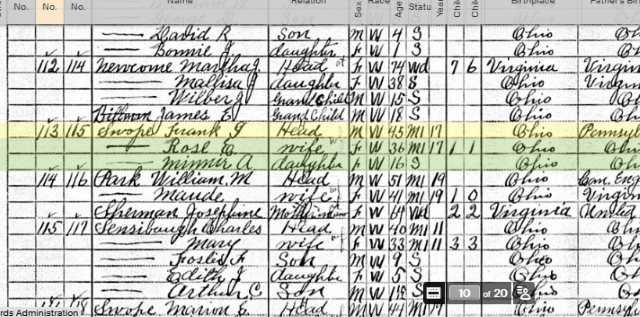
I found Frank and Rose Swope on the Ohio census for 1910. The had a sixteen-year-old daughter, Minnie. You can see that Rose had given birth to only one child and had one living. By 1920 this question had been eliminated, but it’s doubtful that they would have had a seven-year-old by that time anyway. By 1930, Frank and Rose lived by themselves in the same house they had lived in since 1920, but without any boarders. Minnie, I found, had married in 1913 and moved away. Could little Frank have been the Swopes’ grandson, I wondered? Maybe he was visiting and was just hanging around at the Johnsons’ house when the census taker arrived.
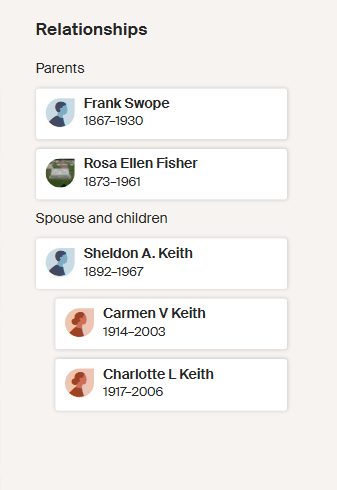
But while Minnie could have had a child the same age as Frank, she only had two daughters, so that idea’s out.
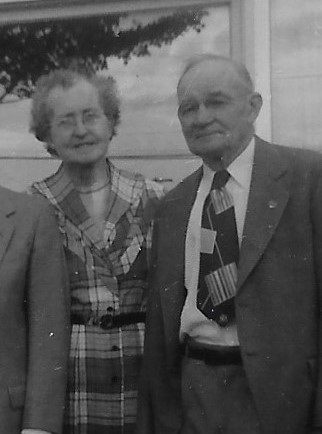
So where does all this leave us? I started looking up things to the effect of “How could a child be listed on the 1920 census who didn’t exist?” What I found both surprised and fascinated me. Apparently the 1920 census had a few characteristics that set it apart from other years. One of them was that the census began on January 1, making it an extremely cold day for some areas. Census enumerators were required to go door to door in sometimes freezing temperatures interviewing each household to get the necessary information. Sometimes they skipped houses because of how cold and uncomfortable they were. However, while their pay was very low, a certain amount of it was determined by how many people were counted each day, creating a small incentive to “add” people as well.
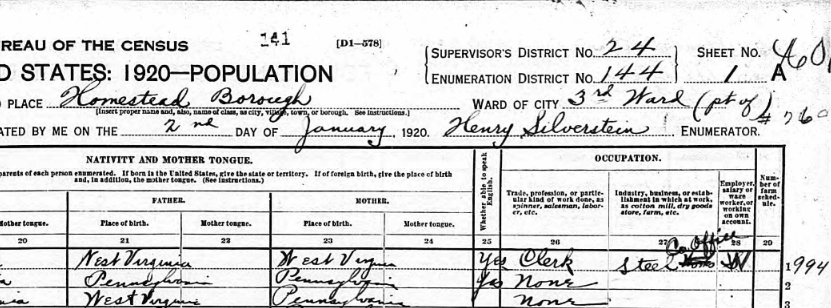
In her fascinating article “When Henry Silverstein Got Cold”, on a site called “Homestead Hebrews” Tammy Hepps describes her research into one 1920 enumerator who fabricated whole neighborhoods in the town of Homestead, Pennsylvania. Apparently, nobody discovered it until Hepps began her research 100 years later. She was looking for data on Jewish immigrant families in the area and wondering why some appeared in no other records except Henry’s census pages. Then she realized that some of the streets and houses he had documented never even existed. I found the same census on Ancestry and sure enough, there was Henry’s name at the top of eleven pages of information, starting on January 2 and ending on January 13, 1920. Hepps’s research is also cited in the article “Detecting Fake People in Historical Records” from the Cambridge University Press website.
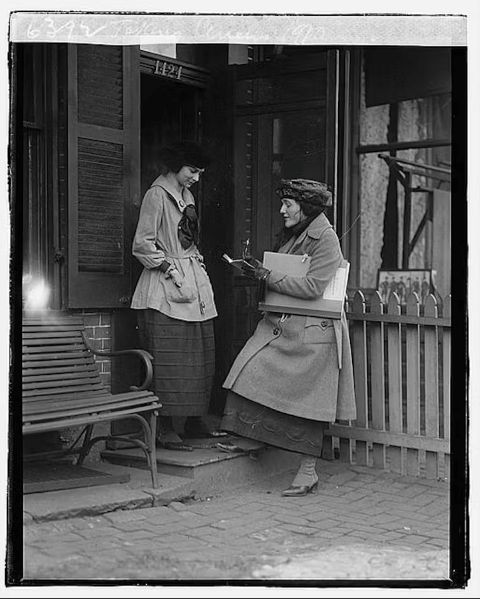
It’s not that I really think Frank Johnson was invented by a census enumerator in 1920, but now I realize that he could have been. The article “Genealogical Mythbusters: Can You Really Trust the Census to be 100% Accurate?” goes into some of the reasons for census inaccuracies, which range from language barriers, spelling errors, miscommunication and even deliberate lies. How hard would it have been for an enumerator to throw in an extra kid every now and then just to boost their numbers? Nothing so extreme as what Henry Silverstein did, but just enough? If they were careful enough, it wouldn’t be noticed. Not until 100 plus years later when somebody like me wants to know what happened to her supposed “first cousin, once removed”? So aggravating!
I guess we could always go back to organizing photos . . .


These are so interesting, but I think it’s so hard to get the right people, places, and all the rest. I am known nearer with what I have been doing. Still, other cousins are better… and also it the right country.
Have you been using Ancestry to research your great aunt? It’s so fascinating, as long as you don’t keep falling down rabbit holes like I do! 😂😂
I have had a look in Ancestry…. oh gosh! 🐰🕳️😂
Made my head spin!
Lol mine, too!
Such an interesting topic! Sad the little white house is no longer there.
Yes it is sad. Some of the places my ancestors lived are literally parking lots or shopping centers now!
I was totally fascinated by this – I had no idea the census could be invented like that! In my research I have found lots of spelling mistakes and such, but invented people is on a whole different level. Thank you for writing about it, I will bear this in mind going forward. Sad about the lost house, I love revisiting historic sites connected to family. The other day I discovered that my grandparents’ old house on an island outside Stockholm was no more – and neither was their lovely garden. A bit sad, but I also know it was an impossibly small house and the new owners did the right thing when upgrading to a new one…
Wasn’t that wild? I had never heard of such a thing either! I also thought later, since there was one line left on the page after Alfred and Madge, and the Frank Swope household had so many people in it, maybe they didn’t want to start them on the last line. How easy would it be to just make up a kid to take up that last space? I think it’s sad about buildings connected with our families being gone when you go to see them or look them up online. The Nels Johnson tailor shop is still there in Ludington, MI, but it’s a yarn shop now. I always think it would be fun to see it in person. 😀
Oh, yes, that is really something with the tailor shop – if you would go there and speak with the current owners, you would probably be able to go in the back of the shop. It’s such a difference seeing it in person – you can imagine their life much better that way!
So, are you feeling sure that Frank was invented? Is there any way of knowing?
My cousin has gone there before and they showed him around. He said it was really cool. I really need to get over my fear of flying lol. I really don’t want to think Frank was invented, but I can’t figure out where he came from or where he went. 🤔 Still, it’s a fun mystery to think about, and I’m not through searching yet!
I root for you – both regarding the flying and finding out more about Frank! 👏💯
Lol thanks! 😊
Love the story it’s very fascinating to read about our ancestors I’m not sure there is a Frank but then I found out I may have an extra relative on my Dad John Powell’s side dad’s been dead since 1972 but he has some explaining to do lol 😬
Yes you never know what you might find out about!